


Invisalign Specialist in Santa Ana, CA
A straighter smile can improve appearance, but orthodontic treatment is also about creating a healthier, more functional bite. For patients who want to straighten their teeth without traditional metal brackets and wires, Invisalign clear aligners offer a removable and less noticeable treatment option. At Bay Dental in Santa Ana, CA, Dr. Linda Pearce, DDS, provides Invisalign and clear aligner treatment based on each patient’s tooth alignment, bite, oral health, and personal smile goals. For more information, contact us today or book an appointment online. We are conveniently located at 3620 S. Bristol St, #307, Santa Ana, CA 92704.
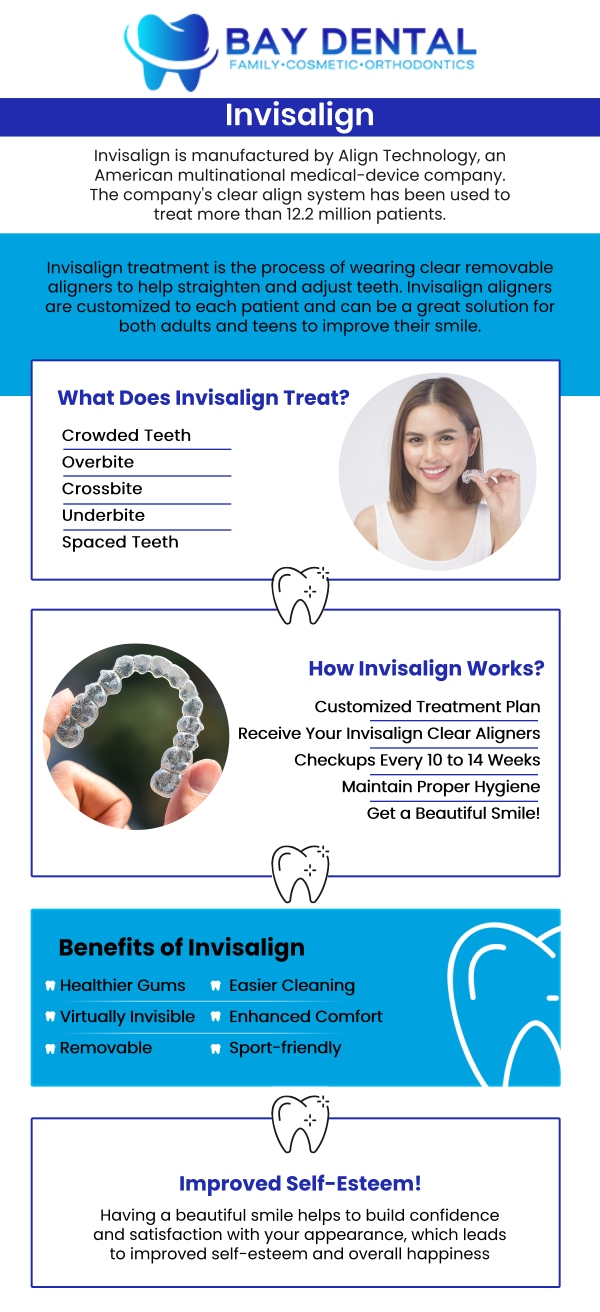
Table of Contents:
What is Invisalign treatment and how does it help improve smile alignment?
Who is a good candidate for Invisalign treatment?
How does Invisalign treatment differ from traditional braces?
How can Invisalign treatment be customized to meet individual smile goals?
How Does Dr. Linda Pearce, DDS Personalize Invisalign Treatment at Bay Dental?
What Should You Know About Invisalign Safety and Treatment Limitations?
Frequently Asked Questions About Invisalign
Invisalign Treatment With Dr. Linda Pearce, DDS, in Santa Ana, CA
Supporting Medical and Practice References
Invisalign is an orthodontic treatment that uses a series of custom-made, clear removable aligners to gradually move teeth into planned positions. Instead of using brackets attached to the teeth and wires that are periodically adjusted, Invisalign treatment uses sequential trays that apply controlled pressure to selected teeth.
Each aligner represents another stage in the treatment plan. As the patient progresses through the series, the teeth gradually shift toward their intended positions. Invisalign treatment requires ongoing professional monitoring so the dentist can evaluate tooth movement, check the fit of the aligners, and determine whether treatment is progressing as expected.
Clear aligners may be used for several types of orthodontic concerns, including:
• Crowded or crooked teeth
• Gaps between teeth
• Certain overbites
• Certain underbites
• Crossbites
• Open bites
Not every orthodontic problem can be treated predictably with clear aligners. The American Association of Orthodontists notes that some cases may be treated more appropriately with braces or another orthodontic approach. A dental examination is therefore important before deciding whether Invisalign is suitable.
A good candidate for Invisalign generally has an orthodontic concern that can be corrected safely and predictably with clear aligners and is willing to follow the prescribed wearing schedule.
Because the aligners are removable, patient cooperation plays an important role in treatment. Aligners generally need to be worn for most of the day and removed mainly for eating, drinking beverages other than water, brushing, and flossing. Invisalign states that patients are commonly instructed to wear their aligners approximately 20 to 22 hours each day, although the appropriate schedule should be determined by the treating dentist.
Before starting treatment, the teeth and gums should also be evaluated. Existing cavities, gum disease, or other oral health problems may need attention before orthodontic tooth movement begins.
Clear aligners may be appropriate for adults and teens with concerns such as spacing, crowding, or certain bite problems. However, treatment suitability depends more on the individual dental condition than age alone.
At Bay Dental, Dr. Linda Pearce can assess a patient’s teeth, bite, existing dental work, and smile goals before determining whether Invisalign or another approach is appropriate. Bay Dental specifically provides Invisalign and clear aligner treatment as part of its dental services.
Both Invisalign and traditional braces are designed to move teeth, but they accomplish this in different ways.
Traditional braces use brackets bonded to the teeth and orthodontic wires to guide movement. They remain attached throughout treatment. Invisalign uses a sequence of removable clear aligners that fit closely over the teeth.
One practical difference is appearance. Clear aligners are much less noticeable than traditional metal braces. They can also be removed during meals and while brushing and flossing, which can make normal oral hygiene easier for some patients.
Because the aligners are removed for eating, patients generally do not have the same food restrictions associated with fixed braces. However, aligners need to be replaced after eating and worn consistently to keep treatment progressing.
Clear aligners also require responsibility. Frequently leaving the trays out can delay progress or cause tooth movement to differ from the planned sequence.
Traditional braces may still be a better option for certain complex tooth movements or bite problems. The American Association of Orthodontists emphasizes that aligners are not appropriate for every patient and that treatment selection should depend on the individual’s orthodontic needs.
No two Invisalign treatment plans are exactly alike because every patient’s teeth and bite are different.
Treatment begins with an assessment of the current tooth positions and the changes that need to occur. Digital information about the teeth can then be used to develop a planned sequence of movements. Invisalign treatment planning technology allows customized aligners to be manufactured according to that individualized plan.
Customization can take several factors into account, including:
• Which teeth require movement
• The direction and amount of movement needed
• Crowding or spacing
• Bite relationships
• Existing restorations
• Overall oral health
• The patient’s cosmetic goals
Bay Dental incorporates digital technology into its dental care and describes using digital evaluation and three-dimensional imaging as part of clear aligner planning. Dr. Linda Pearce can use the clinical examination together with digital information to determine whether the desired changes are realistic and appropriate.
Treatment does not end when the final aligner is completed. Teeth naturally have a tendency to shift after orthodontic treatment. Retainers are therefore generally needed after Invisalign, just as they are after braces, to help maintain the new tooth positions.
Personalized Invisalign treatment begins with understanding more than how the teeth look. Dr. Linda Pearce, DDS, evaluates the patient’s dental condition, alignment concerns, bite, and desired outcome before recommending clear aligner treatment.
Dr. Linda Pearce has more than 30 years of dental practice experience. Her professional profile at Bay Dental identifies training at USC, Tufts University, and UCSF and describes her work in restorative dentistry, cosmetic care, implants, orthodontics, and modern dental technology. She also treats patients with Invisalign and other clear aligner systems.
Bay Dental’s clear aligner process includes digital evaluation, individualized treatment planning, and follow-up visits to monitor tooth movement. This monitoring matters because teeth do not always move exactly as predicted. Adjustments, additional aligners, or other changes to the treatment plan may sometimes be necessary.
Having other dental services available at Bay Dental can also be useful when a patient’s smile goals involve more than alignment. The practice offers preventive dentistry as well as restorative and cosmetic services such as dental crowns, bridges, veneers, and implants. Whether any additional treatment is appropriate depends on the patient’s individual dental needs.
Invisalign treatment is generally well tolerated when appropriately planned and monitored, but orthodontic tooth movement is still a clinical treatment.
Patients may notice temporary pressure or soreness when beginning a new set of aligners. Aligners may also temporarily affect speech or create irritation in some people while they adjust to wearing them.
Good oral hygiene is particularly important. Food and plaque trapped against the teeth by an aligner can contribute to tooth decay or gum problems. Aligners should normally be removed for eating and for brushing and flossing.
Patients should also understand that:
• Treatment length varies according to the complexity of tooth movement.
• Wearing aligners inconsistently can interfere with progress.
• Some patients may require attachments or other orthodontic aids.
• Additional aligners may sometimes be needed.
• Certain complex orthodontic problems may be better treated with braces.
• Retainers are typically required after treatment to maintain alignment.
A professional examination is the best way to determine whether the potential benefits and limitations of Invisalign are appropriate for an individual patient.
How many hours a day should Invisalign aligners be worn?
Invisalign states that aligners are typically worn about 20 to 22 hours per day. They are generally removed for meals, beverages other than water, brushing, and flossing. Dr. Linda Pearce can provide instructions based on an individual’s treatment plan.
How long does Invisalign treatment take?
Treatment time varies considerably. It depends on the type and complexity of tooth movement, how the teeth respond, and how consistently the aligners are worn. A personalized estimate can be provided after the teeth and bite are evaluated.
Can you eat while wearing Invisalign?
Aligners should generally be removed before eating. They are removable, so patients can continue eating most of their usual foods rather than following the food restrictions commonly associated with fixed braces.
Is Invisalign painful?
Patients may experience mild pressure or temporary soreness, particularly after switching to another set of aligners. This is associated with the controlled forces used to move the teeth. Significant or persistent pain should be discussed with the treating dentist.
Can Invisalign treat an overbite or crowded teeth?
Clear aligners can treat many cases involving crowding, spacing, overbite, underbite, crossbite, and open bite. However, the severity and mechanics of the problem determine whether aligners are appropriate. Some cases can be treated more predictably with braces or another orthodontic approach.
Do you need a retainer after Invisalign?
Yes, retainers are generally necessary after orthodontic treatment. Once teeth have been moved, a retainer helps maintain their new positions and reduce unwanted shifting.
Patients interested in Santa Ana Invisalign treatment can schedule an evaluation with Dr. Linda Pearce, DDS, at Bay Dental to learn whether clear aligners are appropriate for their teeth and bite.
Bay Dental provides Invisalign and clear aligner treatment alongside preventive, cosmetic, restorative, and implant dentistry at 3620 S. Bristol St., #307, Santa Ana, CA 92704. Dr. Linda Pearce can develop an individualized treatment plan based on the patient’s dental health, alignment concerns, and desired smile changes.
Bay Dental — Official Practice Website: Confirms Invisalign as a service offered by Bay Dental, along with the practice location and related cosmetic, restorative, implant, and preventive dental services.
Bay Dental — Dr. Linda Pearce, DDS: Confirms Dr. Linda Pearce’s education, more than 30 years of dental practice, use of modern dental technology, and treatment of orthodontic patients with Invisalign and clear aligners.
Bay Dental — Clear Aligners: Confirms the practice’s use of clear aligners, digital evaluation, individualized planning, and ongoing progress monitoring.
American Association of Orthodontists — Clear Aligners: Supports information about how clear aligners move teeth, conditions they may treat, daily wear, oral hygiene, and circumstances in which other orthodontic treatment may be more appropriate.
Invisalign — How Treatment Works: Supports information about digital treatment planning, sequential aligners, follow-up monitoring, and retainers after treatment.
Invisalign — Frequently Asked Questions: Supports general guidance on removable aligners, typical daily wear time, eating, brushing, and flossing during treatment.
Check Out Our 5 Star Reviews

Additional Services You May Need
▸ Restorative Dentistry
▸ Dental Fillings
▸ Dental Implants
▸ All-on-4® Dental Implants
▸ Bone Grafting
▸ Dental Bridges
▸ Dental Crowns
▸ Tooth Extractions
▸ Non-Surgical Root Canal
▸ Dentures
▸ Immediate Dentures
▸ Implant Retained Dentures
▸ Partial Dentures
▸ Denture Care
▸ Exams & Maintenance
▸ Denture Relines
▸ Denture Rebase and Repair
▸ 3d-Printing
▸ Preventative Care
▸ Dental Checkups
▸ Oral Hygiene
▸ Gum Disease Treatment
▸ Periodontal Maintenance
▸ Gum Disease Laser Therapy
▸ Deep Teeth Cleaning
▸ Cosmetic Dentistry
▸ Dental Bonding
▸ Porcelain Veneers
▸ Teeth Whitening
▸ Clear Aligners
▸ CEREC
▸ Invisalign
▸ Same Day Bridges
▸ Same Day Crowns
▸ Ct-Scan
▸ Dental Cleanings
Additional Services You May Need
▸ Restorative Dentistry
▸ Dental Fillings
▸ Dental Implants
▸ All-on-4® Dental Implants
▸ Bone Grafting
▸ Dental Bridges
▸ Dental Crowns
▸ Tooth Extractions
▸ Non-Surgical Root Canal
▸ Dentures
▸ Immediate Dentures
▸ Implant Retained Dentures
▸ Partial Dentures
▸ Denture Care
▸ Exams & Maintenance
▸ Denture Relines
▸ Denture Rebase and Repair
▸ 3d-Printing
▸ Preventative Care
▸ Teeth Cleaning & Dental Checkups
▸ Oral Hygiene
▸ Gum Disease Treatment
▸ Periodontal Maintenance
▸ Gum Disease Laser Therapy
▸ Deep Teeth Cleaning
▸ Cosmetic Dentistry
▸ Dental Bonding
▸ Porcelain Veneers
▸ Teeth Whitening
▸ Clear Aligners
▸ CEREC
▸ Invisalign
▸ Same Day Bridges
▸ Same Day Crowns
▸ Ct-Scan
▸ Dental Cleanings


 Send Text
 How May I Help You?